



Using AI to turn medical records into a competitive advantage for insurance and legal.


All claims teams are familiar with the importance of speed. Very few teams quantify the cost of slowdown.
The cost of delay in injury claims rarely shows up as a single line item. When medical record review and analysis takes too long, it can show up in reserves that require revision, severity that surfaces too late, missed opportunities for early intervention, and claims that progress to litigation while the medical picture remains unclear.
Point of view: The cost of delay in injury claims occurs when teams are unable to understand the full medical story of a claim quickly. The longer it takes to review the medical record, the more difficult it becomes to accurately determine the financial impact and make timely decisions.
When the medical picture remains unclear, uncertainty carries forward into the evaluation phase of a claim lifecycle. Reserves may need to change, severity determinations can surface later than it should, and teams spend more time re-evaluating decisions. The impact of these delays impacts the capacity to fully develop a strategy to resolve or defend the claim.
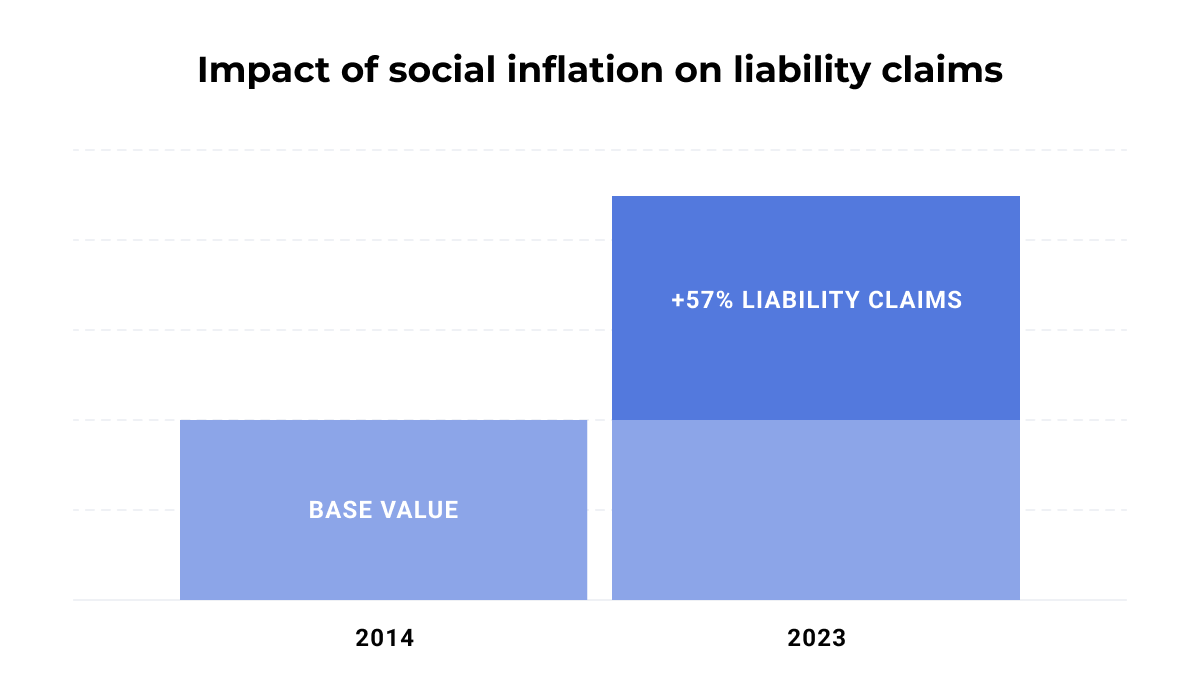
This is especially impactful in bodily injury and casualty claims, where rising severity and litigation costs are increasing the stakes. Social inflation has also increased U.S. liability claims by 57% over the past decade, and in 2023 alone, 27 court cases awarded more than $100 million each.
Workers’ compensation faces a different version of the same problem: complex medical histories, treatment progression, and return-to-work considerations all become harder to manage when key information surfaces late.
The longer it takes to understand the medical and treatment story, the more uncertainty there is in determining the right resolution.
Sometimes, it begins before reading a single page of the medical record. A 2025 Workers' Comp Industry Insights Survey points out that getting information from medical providers has been a top challenge for the last three years running. In a separate survey, Risk & Insurance revealed that almost 56% of claims professionals stated that they simply have too many claims, with each one potentially containing thousands of pages of material, leaving very little time to delve into them.

Consistency within the claims team is another critical factor. The experience and expertise across teams is not uniform, and two competent reviewers can highlight different aspects of the same medical and treatment records. That variability is not represented on a dashboard, but it does affect how, and at what velocity, claims are evaluated and can progress to resolution.
Workers’ compensation offers a useful example of how delay can become more expensive as a claim gets more complex.
A National Council on Compensation Insurance (NCCI) study looked specifically at lost-time claims, with Medical-only claims being excluded. For these more complex claims, the cost is found in medical expenses, wage-replacement benefits, vocational rehabilitation, and the permanency of injuries. This becomes evident in the impact on reserves as claims mature.
That distinction matters. Once a claim includes lost time, return-to-work considerations, or potential permanency, there is more information to gather, more medical history to evaluate, and more opportunity for important details to surface late or even be overlooked.
NCCI found that:
The study measures reporting lag, not medical record review time, so it should not be read as proof that a slower review causes higher claim costs. But it does show what can happen as longer-duration, more complex claims develop without early clarity. The opportunity for early intervention in a treatment plan may be lost when reporting is delayed.
For bodily injury and casualty teams, the pressure is different, but the need is similar: understand severity, treatment history, and potential exposure before uncertainty has more time to compound.
Most claims have a range of outcomes. The sooner that a team understands the claimant's story, what has changed since the incident, and the extent and permanency of the injury, the sooner it can narrow the potential settlement range.
If the review is slow, three things tend to occur:
It can help. Using AI to analyze medical records and provide insights from that analysis can reduce the time spent manually reading and organizing large files. AI-powered medical record summaries make the record easier to review, while medical insights go further by surfacing patterns, timelines, inconsistencies, and changes in severity that might otherwise take hours to identify.
Those insights are most useful when they help claims professionals answer three core questions:
The industry knows what can be done. Bain & Company estimates that generative AI could cut P&C claims leakage by 30% to 50%, and loss-adjusting expenses by 20% to 25%. But there continues to be a gap in adoption. Just 24% of survey respondents reported that they have implemented a beneficial AI or analytics investment.
The objective is not to take the place of claims professionals' judgment. It is to allow them more time to investigate, evaluate, and negotiate.
You don't have to fix everything all at once to lower the cost of delay. Below are six steps that can be taken by claims teams, starting with the easiest changes to make:
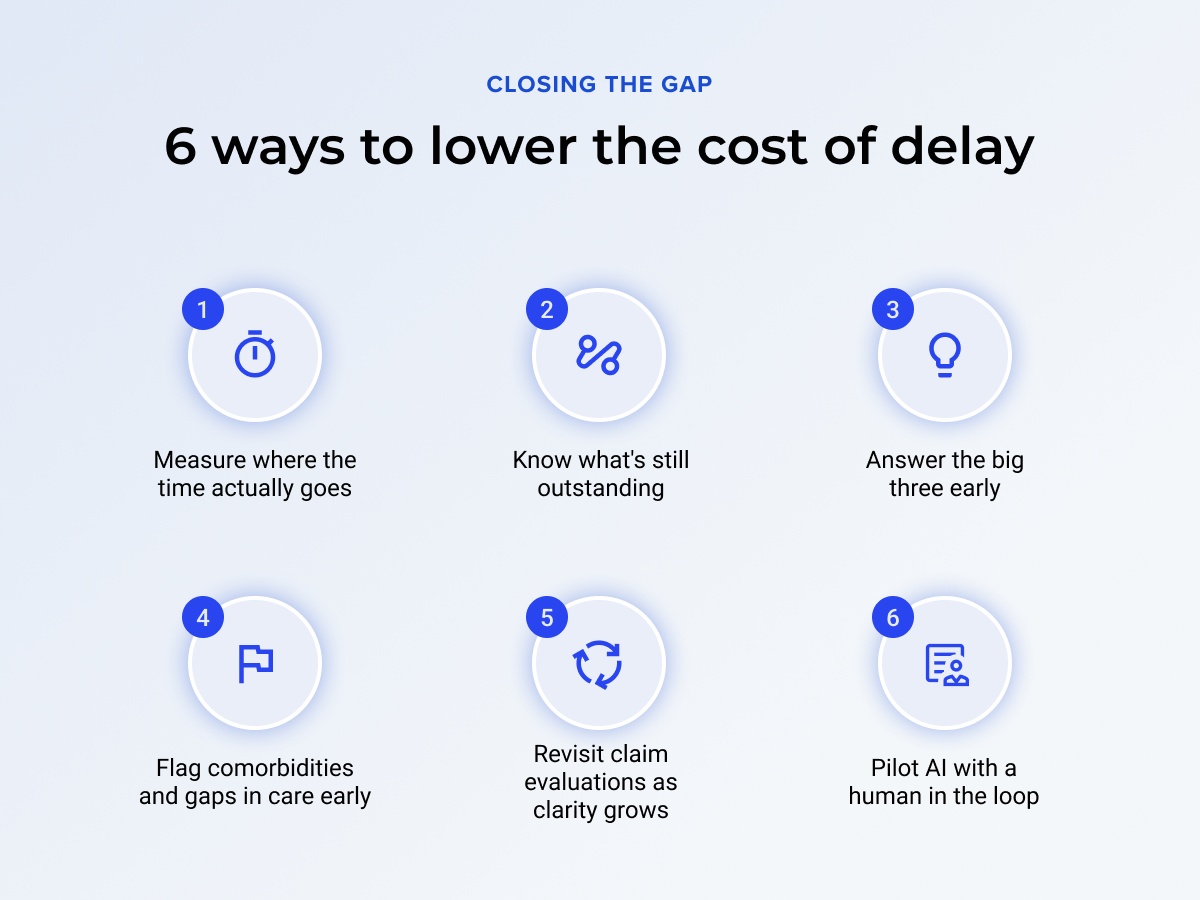
Start by tracking the time frame between claim opening and the first clear severity picture. Search for persistently recurring intervals.
Identify which medical providers are involved in the treatment and which records have been secured or are missing. Incomplete or missing records frequently create delays in evaluation and settlement.
Ensure each file promptly addresses three questions: What is the claimant's medical history? What changed after the incident? How severe and permanent is the injury?
These points can be buried in a lengthy record and influence the evaluation of a claim. Surfacing them early is important to use them in evaluating the treatment and overall settlement valuation.
As new medical information comes in, compare it against the details behind the current claim evaluation. If evaluations are changing significantly once key details surface, that can point to where earlier medical insight would have helped narrow the range of possible outcomes sooner and result in a leading indicator of positive impact through reserve accuracy.
Use AI-powered summaries and medical insights to bring key findings, treatment patterns, gaps in care, inconsistencies, and changes in severity to the surface earlier. The goal: reduce time spent searching through records and focus more on investigation, evaluation, negotiation, and decision-making.
Every day of uncertainty has a price
The cost of delay in claims is real, measurable and escalating. The teams who can see the medical record clearly are better equipped to accurately evaluate their claims and consistently achieve optimal outcomes.
Download DigitalOwl's whitepaper, The Cost of Delay in Claims Decision-Making, for more data, a clear framework for medical insights, and practical ways to reduce uncertainty early in the claim lifecycle.
What is the cost of delay in claims?
The cost of delay is the financial and operational impact of reaching a clear view of claim severity too late. When critical medical information surfaces slowly, teams may face less precise reserves, delayed interventions, more rework, and greater uncertainty as the claim develops.
How does slow medical record review affect claims?
Slow medical record review delays visibility into treatment history, pre-existing conditions, gaps in care, severity, and permanency. That can make it harder to assess exposure early, support reserving accuracy, and determine the right next step while the claim is still developing.
Can AI-powered medical record analysis and summaries improve reserving accuracy?
AI-powered medical record summaries and medical insights can surface critical facts, timelines, treatment patterns, and inconsistencies earlier. That earlier clarity can help claims teams narrow the range of possible outcomes sooner and support more consistent, informed reserving decisions.
What is the difference between AI medical record summaries and medical insights?
A summary tells you what happened in the medical record. Medical insights help explain why it matters, connecting the facts to changes in condition, severity, treatment patterns, inconsistencies, and other factors that may affect the claim.
Does AI replace claims professionals in medical record review?
No. AI can reduce the time spent reading, organizing, and searching through large record sets, while claims professionals remain responsible for evaluating the evidence, applying context, and making claim decisions.

DigitalOwl is the leading machine-learning platform for interpreting medical records and assisting underwriters, claim adjusters, and legal professionals in their work, creating an all-in-one location for medical data review. Their platform uses proprietary AI to address problems that have adversely impacted the medical review process for decades, enhancing the efficiency, accuracy and quality of results for better outcomes.

